Investor Behaviour & Market Volatility
How US Federal Reserve Policy Affects Indian Equities
US Federal Reserve policy has a significant influence on Indian equities through foreign institutional flows, interest-rate expectations, currency movements and global liquidity. This article explains how Fed decisions transmit into Indian stock-market performance and investor behaviour.
By Ankit Tiwari · 25 September 2026 · 7 min read · 53 views
The US Federal Reserve is one of the most important external drivers of Indian equity markets. Its policy decisions do not directly change the profits of Indian companies, but they influence something equally important for financial markets: the global cost of capital.
Changes in US interest rates affect Treasury yields, the US dollar, global risk appetite, foreign portfolio flows and the discount rates investors use to value equities. For India, this transmission is particularly important because foreign portfolio investors continuously compare Indian equity returns with returns available in the United States and other global markets.
The Fed’s Policy Shift: 2024–2026
The Federal Reserve began easing monetary policy in September 2024.
It reduced the federal funds target range by:
- 50 basis points in September 2024
25 basis points in November 2024
25 basis points in December 2024
That represented 100 basis points of cuts in 2024, taking the target range to 4.25–4.50% by December.
In 2025, the Fed delivered another three 25-basis-point cuts—in September, October and December—bringing the target range to 3.50–3.75%.
The direction changed in September 2026. On 16 September 2026, the FOMC announced a 25-basis-point rate increase, raising the target range to 3.75–4.00%, effective 17 September. The Fed stated that inflation remained elevated and that the action was intended to support a more timely return to its 2% inflation objective.
This change matters for India because higher US policy rates can alter the relative attractiveness of emerging-market assets.
How a Fed Hike Can Affect FII/FPI Flows into India
The basic transmission mechanism is:
- Fed rates rise
↓
US yields may become more attractive
↓
Dollar assets offer better risk-adjusted returns
↓
Emerging-market risk premium becomes more important
↓
Foreign investors may reduce allocations to markets such as India
↓
Selling pressure on Indian equities can increase
Foreign investors do not evaluate India in isolation.
Their decision is closer to:
Expected Indian equity return
minus
currency risk + equity risk + valuation risk
versus
return available on US dollar assets at significantly lower risk.
Therefore, if an investor expects a 12–15% return from Indian equities but can obtain a relatively attractive yield from US government securities, the additional return available in India must be sufficient to compensate for equity volatility, currency depreciation and other emerging-market risks.
This does not mean that every Fed rate hike automatically causes FII selling. The reason US yields are rising, movements in the dollar and global risk appetite all matter.
Research from the Bank for International Settlements finds that increases in US yields have historically been more damaging for emerging markets when they coincide with US dollar appreciation, higher term premiums and rising inflation expectations.
The US Dollar Is an Important Part of the Equation
The dollar can be even more important than the interest-rate differential itself.
BIS research examining emerging-market capital flows found that the strength of the US dollar is a major driver of flows into local-currency emerging-market bonds and equities. The research also found that the sensitivity of these flows to dollar strength has increased, particularly for equities.
That creates another transmission channel for India:
- Higher US rates / yields
↓
Potential dollar strength
↓
Pressure on emerging-market currencies
↓
Lower currency-adjusted returns for foreign investors
↓
Potential reduction in FPI appetite
For a foreign investor, the return on Indian equities is not simply the return generated by the Nifty or an individual stock in rupee terms.
The investor ultimately cares about the return after converting that investment back into dollars.
For example, if an Indian equity investment rises 10% in INR terms, but the rupee depreciates materially against the dollar during the same period, part of that equity gain is lost when measured in dollars.
This is why the USD/INR exchange rate is an important component of FII behaviour.
RBI research using Indian data found that higher net FPI inflows are associated with rupee appreciation, while movements in the opposite direction are associated with depreciation. The study also concluded that volatility in portfolio flows driven by global risk-on/risk-off conditions is an important source of exchange-rate volatility in India.
Fed Rates Also Affect Equity Valuations
The Fed affects Indian equities through another channel even if no foreign investor sells a single share:
the discount rate used to value future corporate earnings.
In simplified valuation terms:
Present Value = Future Cash Flow / (1 + Discount Rate)ⁿ
When interest rates rise, the risk-free component of the required return can rise.
Therefore:
Interest rates ↑
→ Required return / discount rate ↑
→ Present value of future earnings ↓
→ Valuation multiples can compress
The Federal Reserve itself explains asset valuation using this framework: asset prices reflect the discounted value of expected future cash flows, and lower interest rates can increase the present value of those future payoffs. The reverse mechanism means higher discount rates can put pressure on valuations, other factors being equal.
This effect is particularly relevant for high-P/E and high-growth stocks, where a large proportion of the company’s assumed value depends on profits expected many years into the future.
That can include segments such as:
Technology
Consumer growth companies
New-age businesses
High-growth midcaps
Other long-duration equities
The issue is not necessarily that these companies suddenly become weaker businesses. Instead, investors may become unwilling to pay the same multiple for future earnings when the global risk-free return has increased.
Why Good Indian Earnings Can Coexist with FII Selling
This explains an apparently contradictory market situation:
Indian corporate earnings can remain healthy while FIIs continue selling.
There is no contradiction.
Domestic fundamentals answer one question:
How much can Indian companies earn and grow?
Global asset allocation answers another:
Is the expected return from Indian equities attractive enough relative to the returns available elsewhere after adjusting for risk and currency movements?
RBI research has also found that US monetary-policy shocks transmit into India primarily through the financial channel in the post-2008 period, influencing domestic financial conditions and ultimately economic activity.
Therefore, FII selling should not automatically be interpreted as evidence that investors believe India's long-term economic fundamentals have deteriorated.
Sometimes the global opportunity cost of holding Indian equities has simply increased.
The Key Framework for Indian Investors
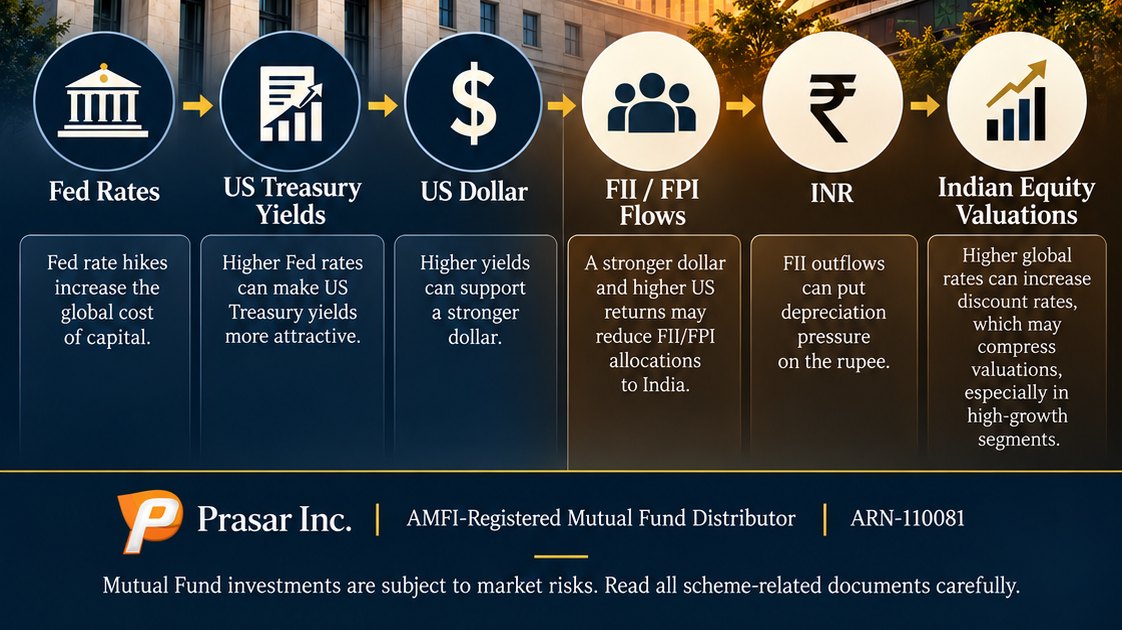
The relationship should therefore be understood as:
- Fed policy
↓
US Treasury yields
↓
US dollar and global risk appetite
↓
FII/FPI allocation decisions
↓
INR movement
↓
Indian equity liquidity and valuations
At the same time:
- Higher global interest rates
↓
Higher discount rates
↓
Lower present value of future earnings
↓
Potential P/E multiple compression
The September 2026 Fed hike therefore matters not because a Fed hike automatically means Indian equities must fall, but because it changes the global risk-return equation facing international investors.
The most useful question is not simply:
“Is India growing?”
It is:
“Are Indian equities sufficiently attractive, after accounting for valuation, currency risk and expected returns, compared with the alternatives available to global capital?”
That is the fundamental link between the Federal Reserve, FII flows and Indian equity valuations.